
A Journey through Ashes
Ash Wednesday seen through Middle‑earth’s desolations and the forty‑day quest from Lothlórien to Mount Doom

This year, I found myself thinking about Lent from an unexpected angle. The Christian symbolism of the destruction of the Ring on 25 March, is well known, this date traditionally associated with both the Annunciation and the Crucifixion. Similarly, there are obvious parallels between the ascent to Mount Doom and the Way of the Cross.
But while working on my recent article “I’ll Be an Orc No More,” I came across a detail that caught my attention and perfectly complements this symbolism. If we look at the last part of the journey, from Lothlórien to Mount Doom, the path of Frodo and Sam is increasingly dark (except for a few brief moments of light and rest), it is a journey through wilderness, shadows and desert, hardship, fear, hunger, temptation, and perseverance. And when I counted the days according to the Shire calendar, I found that from the Fellowship’s farewell to Lórien to the destruction of the Ring it takes exactly forty days, just like the forty days of Lent.
I’ll Be an Orc No More

Some scenes can be easily overlooked, yet they carry a quiet significance and symbolism. One of them appears in Mordor on the way to Mount Doom. Frodo is exhausted by the growing burden of the Ring and Sam suggest that he could carry it for a while, which provokes a passionate rejection by Frodo (like earlier in the Tower of Cirith Ungol when he found o…
Beginning on Ash Wednesday, Catholics enter the liturgical season of Lent when we recall that we are fallen creatures in constant need of God’s love and grace. The Church invites us into a season of repentance, self‑denial, and reflection; a forty‑day pilgrimage through the desert with Christ. The sign of ashes on our foreheads serve as a reminder that we are pilgrims walking through this “vale of tears” in search of the path to our Heavenly home.
Tolkien understood this anthropology deeply. His world is full of characters who must confront their frailty and who grow not through strength but through humility.
But let’s talk a little more about the symbolism of ashes in Tolkien’s work.
Ashes in Middle‑earth
It is interesting how deeply Tolkien threads the image of ash through The Lord of the Rings. I recommend reading the essay Ashes in The Lord of the Rings on Thoughts on Tolkien website. The author observes that the word appears roughly twenty times in the book. Four references are the residue of an ordinary fire: Ashes from a fire in the snow in the Redhorn Gate, ashes from a watch-fire near Fangorn, ashes from Sam’s cooking fire in Ithilien, and ashes falling from burning trees after Gandalf saved the Fellowship from wolves.
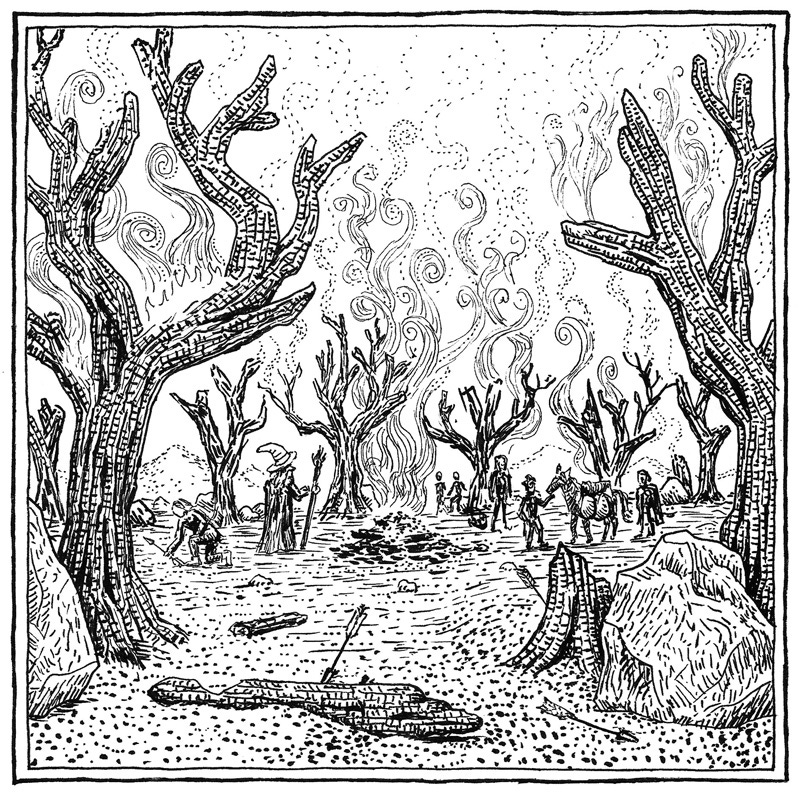
Many references to ashes are descriptions of landscapes. However, these are not ordinary landscapes, but something closely connected with the evil power and its workings: desolation before the Black Gate of Mordor, the burned aftermath of the battle of the battle of the Pelennor Fields, the “mass of ash” at the foot of Mount Doom, and the “hot ash” falling after the explosion of the mountain.
If we leave The Lord of the Rings for a moment, we will find ashes in The Silmarillion as the aftermath of great ruin. The dark lord Morgoth’s scorching of Ard‑galen into the choking wasteland of Anfauglith is one of the earliest and most haunting examples. A vgreen plain becomes a gasping desert of ash — a landscape where hope seems impossible, where the earth itself bears witness to the violence done to it.
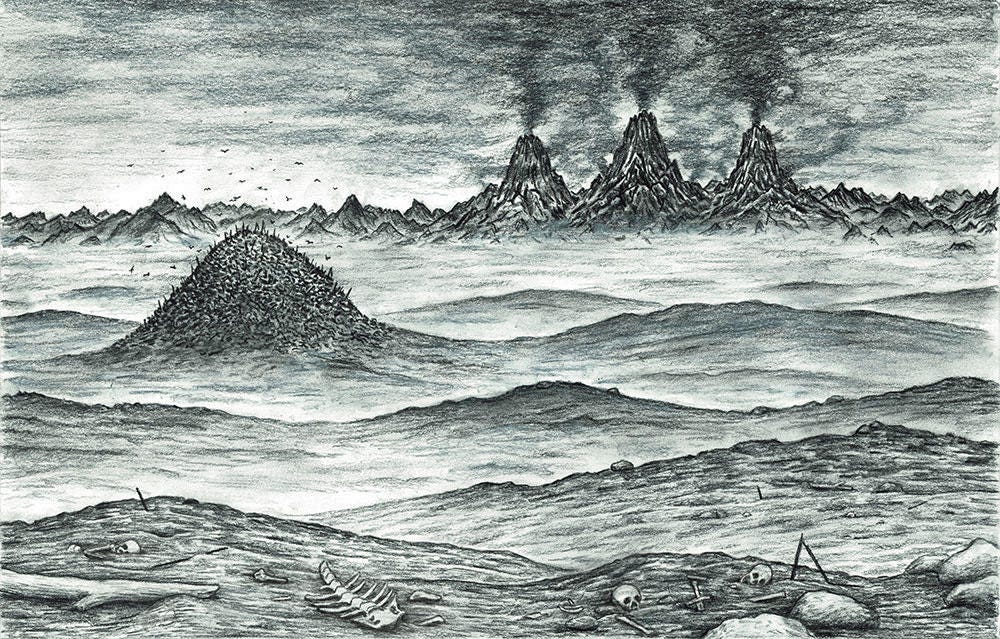
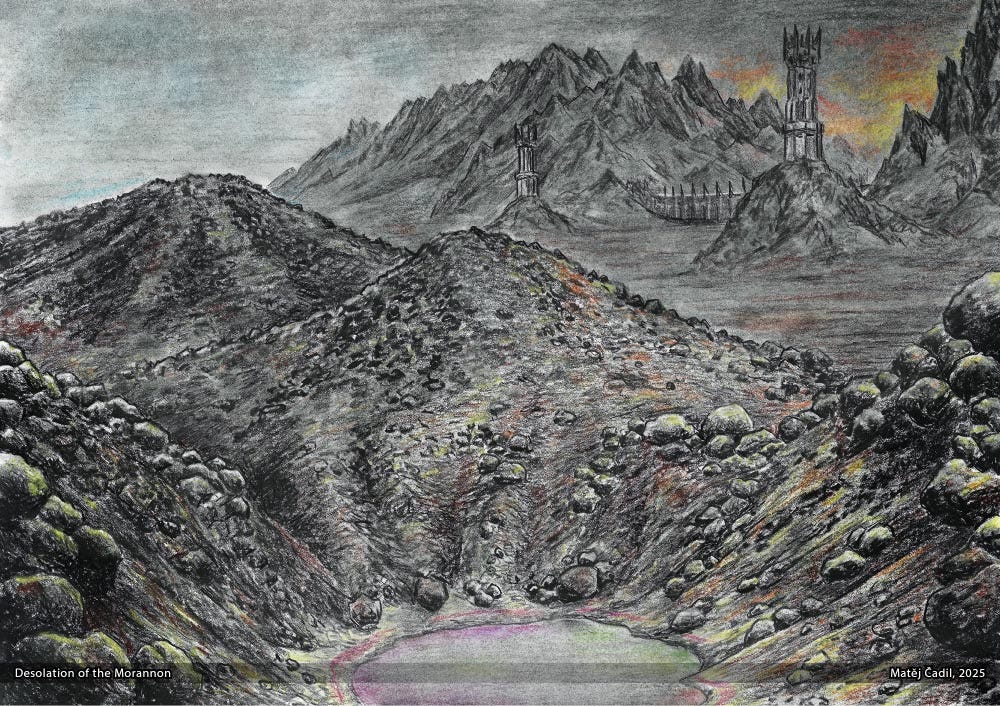
This pattern continues into the Third Age. The Desolation of the Morannon, with its slag‑heaps, fumes, and ashen dust, is another place where the land in front of a dark lord’s domain has been reduced to a kind of moral residue. Nothing grows there, the ground is poisoned, the air unwholesome. It is the visible imprint of Sauron’s will: a will that consumes, corrodes, and leaves only ash behind.
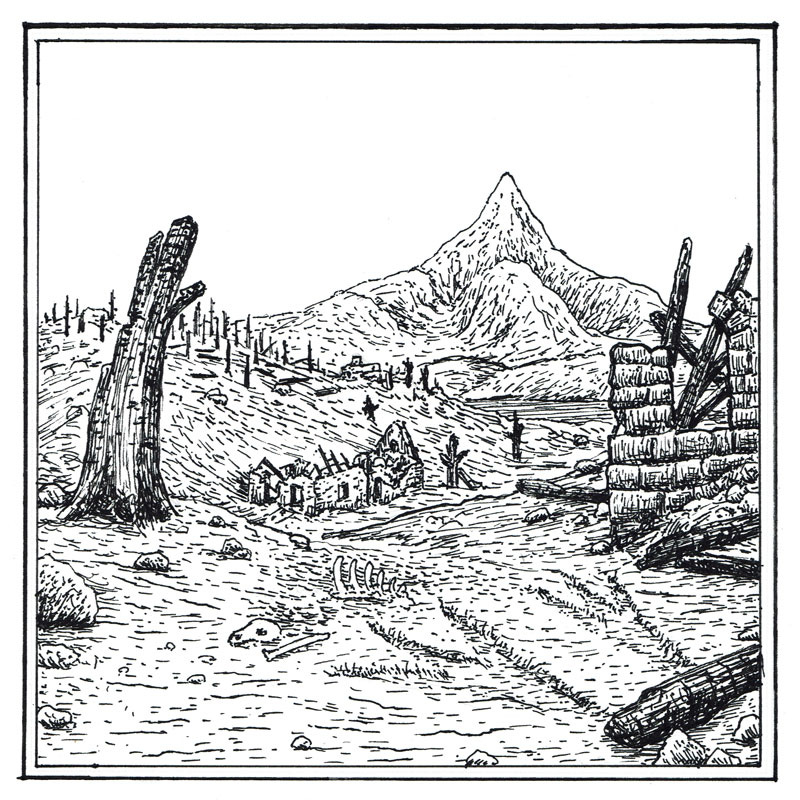
And we can see a similar thing on a smaller scale in The Hobbit, when Thorin’s company comes to the Desolation of the Dragon, a land described as bleak and barren with only broken and blackened stumps of trees. In these places, ash is not neutral. It is a testament to the damage that evil can cause to the world.
But Tolkien also uses the symbolism of ashes on a more personal level, related to death. And most notably in the case of Gollum. When he describes Mordor to the hobbits, he says “Ashes, ashes, and dust”. And this is echoed later on the slope of Mount Doom where Gollum begs Sam to spare his life:
“Lost lost! We’re lost. And when Precious goes we’ll die, yes, die into the dust.’ He clawed up the ashes of the path…’Dusst!’”
So, as the author of the Thoughts on Tolkien essay observes, here we see the explicit connection drawn by Tolkien: death is about “ashes” and “dust.” But Gollum’s moral ruin is also foreshadowed when Gollum tries to taste lembas:
“Dropping the leaf, he took a corner of the lembas and nibbled it. He spat, and a fit of coughing shook him. ‘Ach! No!’ he spluttered. ‘You try to choke poor Smeagol. Dust and ashes, he can’t eat that. He must starve.”
In this scene, lembas is evocative of the Eucharist, which Catholics believe is the Body and Blood of Christ. The Catholic Church also teaches that you should repent of your sins before receiving the Eucharist. Those who eat unworthily, like Gollum, “eat judgment against themselves.” Although Gollum still had the opportunity to repent later, his rejection of the lembas foreshadows that he will return to dust and ashes and die, both physically and, above all, morally, as a result of judgment for his evil deeds.
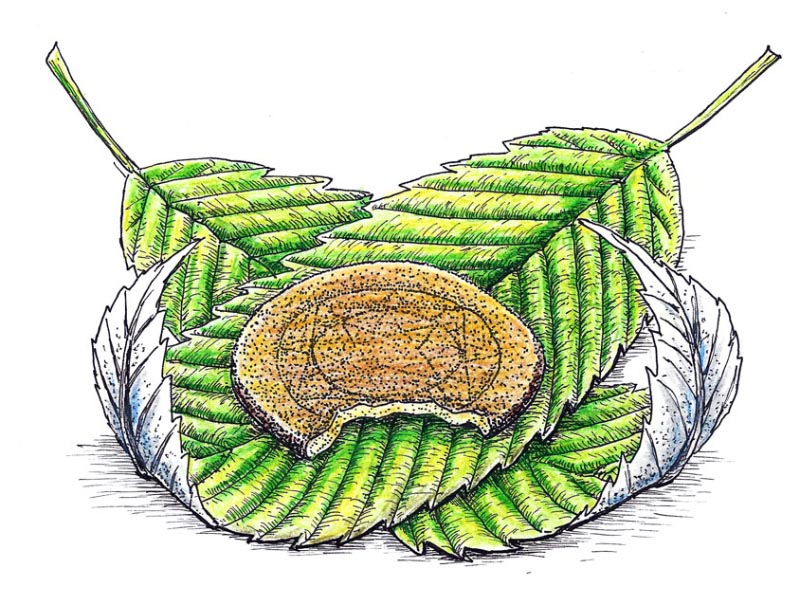
Another interesting example is Denethor, who uses ash as a symbol of death in despair when he intends to burn himself and Faramir together with the destruction of Minas Tirith:
“It shall all go up in a great fire, and all shall be ended. Ash! Ash and smoke blown away on the wind!”
We can contrast this to the approach of Aragorn, who does not burn even the dead White Tree of Gondor, but lays it to rest in the Hallows in Rath Dínen. And when he finally dies himself, he dies with hope, not despair like Denethor. Ashes in The Lord of the Rings remind us of death and the proper way to approach it.
But ashes can also be a symbol of renewal. In Bilbo’s Riddle of Strider we read:
From the ashes a fire shall be woken,
A light from the shadows shall spring;
Renewed shall be blade that was broken:
The crownless again shall be king.
And so, just as the pyre of Denethor burns out and Gandalf says “Denethor has departed, and his house is in ashes”, the shadows of Mordor are blown away and Aragorn arrives with his renewed blade Andúril, “Flame of the West” and is ultimately crowned the new King of Gondor.
The discovery that the final stretch of the Quest lasts forty days, like the season of Lent, shed new light on Tolkien’s ash-covered landscapes for me. Those forty days are spent walking through ruin. Over the slag-heaps of Morannon, across the barren plain of Gorgoroth, and up the mass of ash at the foot of Mount Doom. So we step into Lent like travelers setting out from Lothlórien and the ashes placed on the forehead of the faithful are meant to remind us about the ruin sin leaves behind, but also that grace can work even in the most ashen places and that the road through ashes and dust can lead to renewal.
Most of the thoughts in this post are inspired by the essay Ashes in The Lord of the Rings on Thoughts on Tolkien. There’s a lot more in it and I really recommend reading it.
Thanks for this as always! Yes, the parallels are striking (eg the Way of the Cross, wow, never encountered that one, yes!!). "Ashes to ashes, dust to Dust"...the cyclical nature of hardship and renewal, that is the Estel. 👏🏻🙏🏻
Such a great post and your images captured it so perfectly.